
 $ USD
$ USD
Click HERE to download the Ready-Fire wiring diagram PDF
Installing the Ready-Fire Electronic Ignition Conversion Kit
Introduction
The Ready-Fire Electronic Ignition Conversion Kit is designed to replace traditional breaker points and condenser in various distributor models, providing improved reliability and reduced maintenance. These instructions will guide you through the proper installation and setup of the Ready-Fire ignition system.
Pre-Installation Checklist
- Ensure the battery is fully charged.
- Confirm that the charging system does not exceed 13.7 volts at the coil’s positive terminal at any RPM.
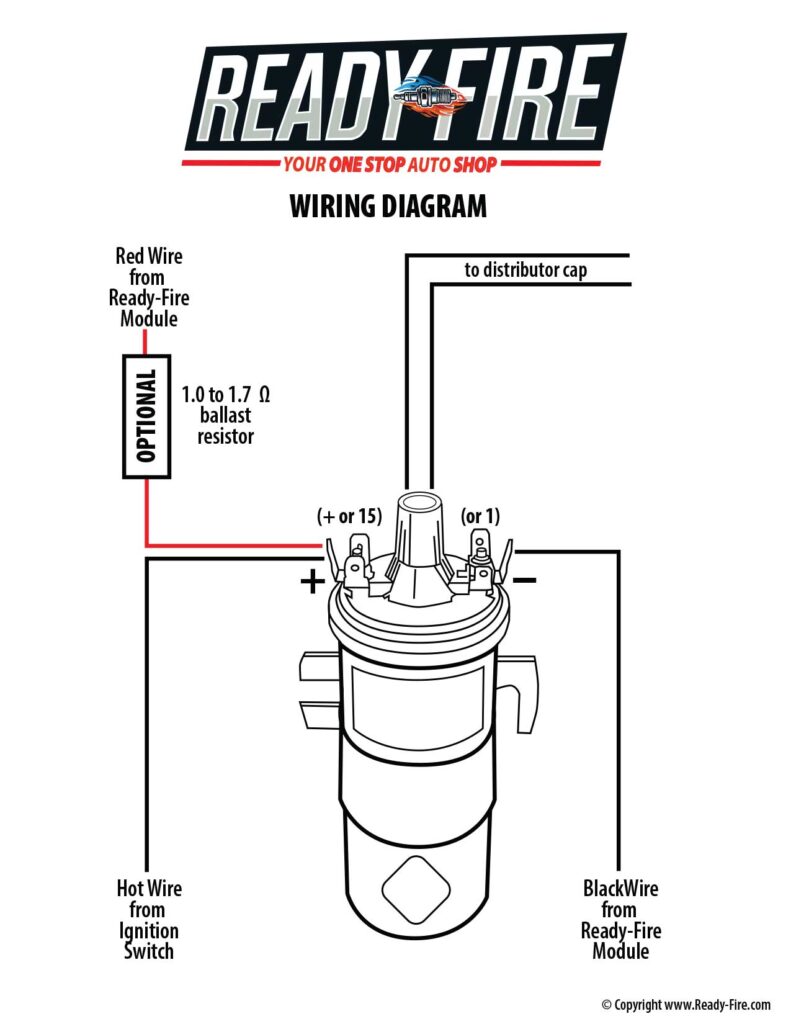
- If voltage exceeds this, the voltage regulator may need replacement. Alternatively, install a 1.0-1.7 ohm external ballast resistor between the coil’s positive terminal and the Ready Fire ignition’s red wire.
Required Tools
- Screwdrivers (Flathead and Phillips)
- Wrench set
- Digital Multimeter (200-ohm and 20k-ohm settings)
- Timing Light
- Thermal Transfer Paste (provided)
Installation Steps
1. Remove Old Components
- Disconnect the battery’s negative terminal.
- Remove the distributor cap, keeping wires attached unless replacing the cap.
- Remove the rotor.
- Detach and discard the existing points and condenser.
- Clean the interior of the distributor to remove grease and debris.
2. Install the Ready Fire Ignition Module
- Apply a thin, even layer of the supplied thermal paste to the bottom of the ignition module.
- Secure the ignition module to the breaker plate using the provided screws.
- Align and install the magnetic sleeve over the distributor shaft, ensuring it sits securely.
3. Wiring Connections
- Connect the red wire from the Ready Fire module to the positive (+) terminal of the ignition coil.
- Connect the black wire from the Ready Fire module to the negative (-) terminal of the ignition coil.
- Route wires safely, avoiding sharp edges, heat sources, and moving components.
4. Reassembly
- Reinstall the rotor.
- Place the distributor cap back, securing all connections.
5. Final Testing and Timing Adjustment
- Reconnect the battery’s negative terminal.
- Start the engine and allow it to idle.
- Use a timing light to adjust ignition timing according to manufacturer specifications.
- Ensure stable engine operation.
Important Notes
- The ignition coil must have at least 3.0 ohms primary resistance for proper function.
- If the voltage at the coil’s positive terminal exceeds 13.7V, use a ballast resistor.
- This system is designed for 12V negative ground electrical systems only.
- Regularly inspect connections and components to maintain performance.
